
If you have been searching for “New Landlord Rules Ireland” and seeing references to six-year tenancies, here is the plain-English explanation.
For new tenancies created on or after 1 March 2026, tenants gain stronger security once they have lived in the property for six continuous months, unless a valid Notice of Termination has been served before that point.
When the six-month mark passes, the tenancy becomes a Tenancy of Minimum Duration (TMD). This creates a rolling six-year period of security for the tenant.
Tenants are not locked in for six years, because they can still leave with the correct notice. The practical change is on the landlord side: once the TMD applies, the circumstances where a landlord can end the tenancy become much more limited.
Quick answer: what are the new landlord rules in Ireland?
For tenancies created on or after 1 March 2026, Irish tenancy law introduces a Tenancy of Minimum Duration (TMD) lasting six years.
Once a tenant has lived in the property for six continuous months, the tenancy automatically enters this protected period unless a valid Notice of Termination was served before that point.
During the six-year period:
- landlords can only end the tenancy using specific legal grounds, and
- a Notice of Termination must be sent to both the tenant and the RTB.
Tenants are not required to stay for six years, but landlords face significantly tighter restrictions on ending the tenancy once the TMD applies.
The simple change: "six months in, six years security"
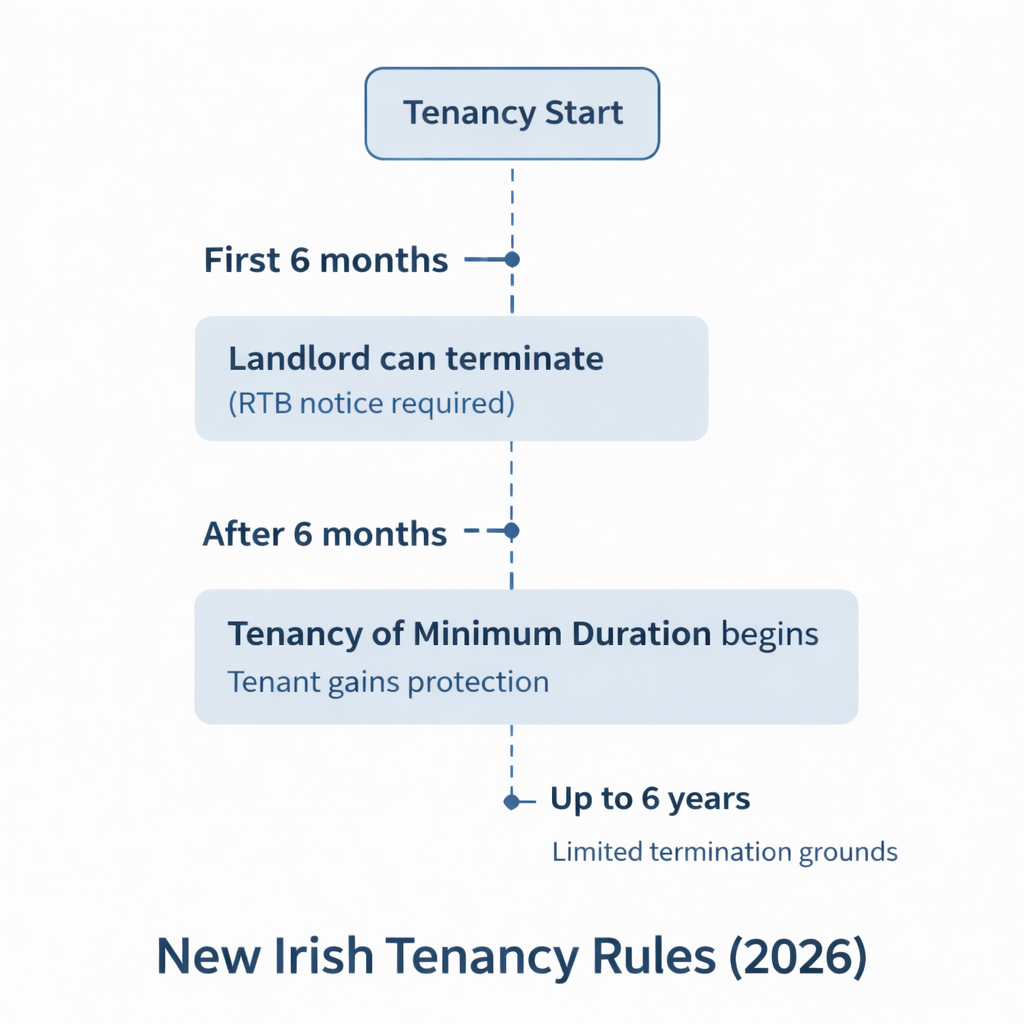
The new rules divide a tenancy into two stages.
First 6 months
All landlords can end the tenancy during the first six months. In practice this can still include termination without giving a specific reason, but from 1 March 2026 the RTB expects landlords to formally serve a Notice of Termination and copy it to the RTB.
After 6 months
If the tenancy reaches six continuous months without a valid termination notice, it automatically becomes a Tenancy of Minimum Duration.
At that point a landlord can only end the tenancy for specific legal grounds, and the available grounds depend on whether the landlord is classed as a small landlord or a large landlord.
In practical terms, the first six months are now the key decision window. Once that window closes without a valid notice, the tenancy moves into a much more protected legal position.
Small vs large landlords: who can end a tenancy, and when
For tenancies created from 1 March 2026, RTB guidance distinguishes between two landlord categories.
- Large landlords: landlords with 4 or more tenancies, and company landlords
- Small landlords: landlords with 1–3 tenancies counted on the day the notice is served
The available termination grounds during a Tenancy of Minimum Duration depend on this classification.
Below is the practical overview for ending a tenancy after the first six months.
| Ground to end tenancy (post-6 months) | Small landlord (1–3) during 6-year cycle | Small landlord at end of 6-year cycle | Large landlord / company landlord |
|---|---|---|---|
| Tenant breach (e.g. rent arrears or other breaches) | Allowed, subject to correct process | Allowed | Allowed |
| Dwelling no longer suits tenant needs | Allowed | Allowed | Allowed |
| Sell with vacant possession | Only in hardship scenarios during cycle | Allowed if notice served before cycle end | Not allowed |
| Landlord or family needs to live there | Only in limited cases during cycle | Allowed | Not allowed |
| Substantial refurbishment or change of use | Not during cycle | Allowed | Not allowed |
One point that often causes confusion is property sales.
Large landlords can still sell a property, but typically must do so with the tenant in place. In RTB terms, the buyer steps into the position of the landlord and the tenancy protections continue.
Selling, moving in, refurbishing: what's still allowed
The major practical change under the new landlord rules is not that termination becomes impossible, but that the available routes narrow significantly once the TMD protections apply.
For small landlords, selling the property, moving into the property, allowing a family member to move in, or carrying out major refurbishment may still be possible in some circumstances. However, timing becomes critical.
During the six-year cycle these grounds are limited and may require additional justification, such as hardship tests or statutory declarations. At the end of the six-year cycle, small landlords generally regain broader termination options if notice is served correctly before the cycle ends.
For large landlords, the position is considerably more restricted. After the first six months, the main available grounds are typically:
- tenant breach, or
- the dwelling no longer meeting the tenant's accommodation needs.
Because of these limits, large landlords often need to plan ahead if a property may later be sold, redeveloped, or repurposed.
Notice of Termination: the new "send to tenant and RTB" discipline
One of the most important procedural changes concerns how termination notices must be served.
According to RTB guidance, a valid termination generally requires four steps:
- prepare the written Notice of Termination,
- give the correct statutory notice period,
- satisfy the legal ground and any evidence requirements, and
- send a copy of the notice to the RTB on the same day it is sent to the tenant.
Certain termination grounds also require a statement and/or statutory declaration, and the RTB templates are designed to include the necessary wording.
For landlords managing multiple properties, it is safest to treat the RTB submission as part of serving the notice itself. A notice that is prepared but not copied to the RTB on the same day creates a compliance risk.
A short checklist to stay compliant
Before serving any termination notice, run through a simple compliance check.
| Step | Do this | Proof to keep |
|---|---|---|
| Check you are allowed to terminate | Confirm tenancy start date, whether the tenant has passed 6 months, and your landlord size classification | Tenancy records and tenancy count |
| Use the correct RTB template | Download the RTB Notice of Termination template for the correct ground | Saved PDF and template version |
| Attach required declaration | Some grounds require a statutory declaration or supporting statement | Signed declaration and supporting evidence |
| Serve properly | Serve the tenant and copy the RTB the same day | Email records, postage receipts, RTB confirmation |
| Respect notice periods | Use the RTB notice period table | Calculation record and calendar entry |
Three practical habits make compliance much easier:
- Create a simple internal rule: no notice is served until it is also filed with the RTB.
- If relying on hardship, treat it as a file you may need to defend later.
- Avoid improvising declarations — use RTB templates whenever possible.
Short FAQ
Does the 6-year TMD apply to my existing tenancy?
No. The six-year Tenancy of Minimum Duration applies to new tenancies created from 1 March 2026. Existing tenancies generally continue under the previous legal framework.
I am a large landlord. Can I end a TMD to sell?
In most cases, no. Large landlords have limited termination grounds during a TMD. However, they can still sell the property with the tenant in place, with the buyer becoming the new landlord.
Can I end a new tenancy in the first 6 months without reason?
Landlords can still end a tenancy during the first six months. However, from 1 March 2026 the RTB expects landlords to follow the formal notice process and copy the Notice of Termination to the RTB.